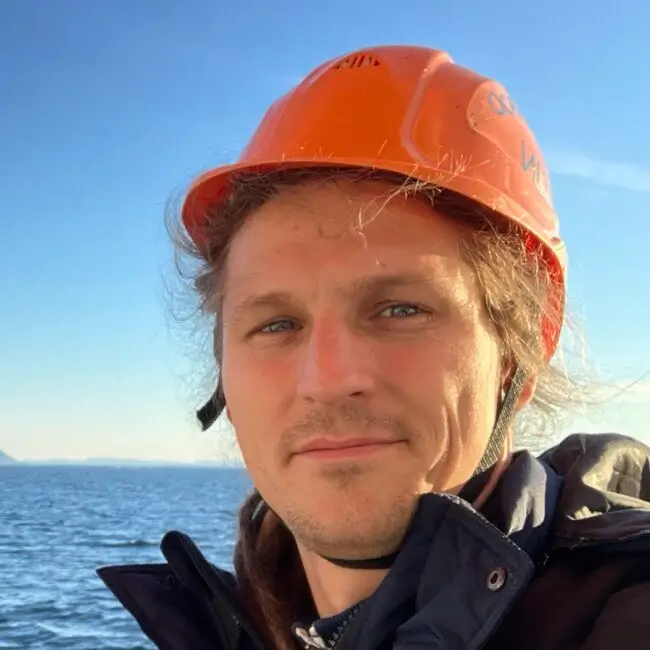
Ocean Season: Dreams, Arctic Expeditions, And The Quest For Every Country

— Alexander, you recently published a book, This Unknown Ocean, and it’s one of the few works on oceanology in the popular science genre in Russian. How did you come up with the idea to write it?
— I often agree to participate in various activities: for example, giving lectures at universities and schools. Even if it’s not particularly convenient for me, I still try to do it because it will benefit others. The same thing happened with the book: I got a phone call from Bombora Publishing House, “You’re already giving wonderful lectures, would you like to write a book about oceanology?”
I should mention that I’ve been regularly asked during lectures about oceanology-related reading material, but such popular science books are practically nonexistent in Russian.
There are practically no books that cover physics, geology, and navigation, except perhaps Soviet ones… So I really fancied the idea of writing a book on oceanology: it’s a kind of gap that needs to be filled.
— Is writing a popular science book more difficult than writing a traditional academic paper?
— I certainly understood that writing a book is a difficult task, but I had no idea just how difficult… I expected that digitising my lectures and podcasts would help, but in the end, they only made up one-fifth of the book. Then I wrote from scratch.
It takes about an hour to write around a thousand characters. So, 300,000–400,000 characters is 300–400 hours of writing. Fact-checking takes a lot of time as well: to understand unfamiliar fields, you first need to read the material, put it together logically in your head, and explain it. Numbers are especially important, which is why, among other things, I didn’t use artificial intelligence in my writing. As a researcher, you’re responsible for the veracity and accuracy of what you say. Therefore, everything needs to be double-checked.

Later, the idea for the Telegram channel came up. I’d been wanting to start a blog for a long time, but I was always deterred by the required time investment and effort it required. I also couldn’t figure out a format: what should I write about? Travelling? Everyone writes about travel, and I didn’t want to become just another travel blogger. I wanted to do something interesting for myself and for others. Then an idea struck: why not start a channel about oceanology?
I set a publishing schedule for the channel, and it really helped me while writing the book. I set a goal to post 2-3 times a week, as well as some topics to cover, and the book gradually began to take shape. Finally, by April, thanks to the blog, the text was actually written. Then came editing, laying the structure out, and preparing for publication.
— Somerset Maugham had a funny comment about writing routine: “I write only when inspiration strikes. Fortunately it strikes every morning at nine o’clock sharp.” Did you write on a schedule or spontaneously?
— Most often, spontaneously. It happened at night, on weekends, on planes, and on trains. It’s all time taken from the mundane task. No one has cancelled the work…
At the same time, popular science writing doesn’t correlate with my main academic work; I usually write texts of a completely different nature.
— What is the future of your blog?
— For now, I’ve chosen the natural course of events—writing a second book—because some of the text didn’t make it into the first. For example, descriptions of some of the islands I visited.
I’ll be gathering information and preparing a work specifically focused on the islands, but in a more patient manner, without haste. In the blog, I’ll write about my research, the life of an oceanographer, expeditions, and travels.
— You recently had two expeditions: first, you traveled to the North Pole on the “Icebreaker of Knowledge”—50 Years of Victory—and three weeks later, you moved on to Kamchatka, right?
— Yes, there were two expeditions. Incidentally, there was no internet on the “Icebreaker of Knowledge,” and I finished the book without interruption. During the entire expedition, except for the day we set out for the North Pole, I had quite a bit of free time. I sometimes wrote for ten hours a day. After the expedition, I spent one day in Moscow and flew to Kamchatka. There, I had three days of preparation on shore, and then set out for a month and a half at sea for the next expedition.

— Visiting the pole was your dream, wasn’t it?”
— Yes, and it was wonderful. It was truly my dream, both as a geographer and simply as someone who frequently visits the Arctic. I hadn’t been to its centre yet.
Truth be told, there’s nothing particularly interesting at the pole itself. There’s no curious physical effect, the Earth’s axis doesn’t stick out from the pole…
However, I was incredibly intrigued by how compact the ice was, what the ice fields looked like, the puddles and snowdrifts on the ice. I imagined myself preparing for research and analysed how I could work here, how I could organise measurements.
It was interesting to see that the ice wasn’t very compact, with all those puddles, cracks, and leads. It was a great surprise for me. Of course, I’d long known that the pole now has first-year ice one and a half to two metres thick, but seeing it was a completely different matter. There’s still thick, compact ice in the Canadian Arctic, but in other parts of the Arctic…
Previously, a nuclear-powered icebreaker was essential for reaching the pole. Now, I think a diesel-powered icebreaker would do the trick, and two diesel-powered icebreakers in a tandem—most definitely.
I was also lucky to encounter a bear on the ice; they’re more common on the islands, so it was a surprise. He was in good spirits: he flipped around, came alongside the ship, and stood up…

— What’s your dream now? What’s ahead?
— I still have a dream of visiting every country in the world. It’s almost over; soon there will only be three left. I think I’ll have visited them all by the May holidays in Russia.
— What countries are left?
— I’ll have two trips before the New Year: the first to Oceania (Nauru, Kiribati, Micronesia, the Marshall Islands), and the second one around New Year’s (Zambia, Zimbabwe, Botswana, Malawi). After that, there will be exactly three left: Madagascar, New Zealand, and Yemen. Yemen has been going through a long-standing civil war, making it very difficult to get into. I usually try to visit the capital, but in this case, I’ll have to compromise and visit the more peaceful half of the country. Madagascar and New Zealand are incredibly interesting countries, so I deliberately saved them for last.”
— Is it worth visiting every country in the world?
– To broaden your horizons, it’s probably worth visiting 70 countries. That’s more than enough. According to the Pareto principle: visit 20% of the world, get 80% of the results.

— Was this your first time in the Chukchi Sea?
– Yes, it’s because it’s logistically difficult to get to. We have, roughly speaking, two clusters of ports: Murmansk and Arkhangelsk in the European part, and Vladivostok in the Asian part. We can almost always only depart from these ports, but the Chukchi Sea is located right in the middle between both clusters, so it’s the least visited sea. It takes two weeks to get there.
Naturally, I’d like to work on expeditions closer to the target sea, with a voyage of maximum 20 days, rather than a month. It’s important to remember that you don’t get to work all those days—you’re just waiting for arrival.
I first started thinking about an expedition to this sea in 2019. Finally, the opportunity arose! In this case, we got lucky: previous research group had left a vessel in the port of Petropavlovsk-Kamchatsky instead of Vladivostok, which significantly shortened the journey for us.
— Is the Chukchi Sea different from others in any way?
— It’s perhaps the most complex sea we have in Russia: in terms of the number of different interactions with water masses, in terms of the number of different processes observed there. It’s very interesting that the American part of the Chukchi Sea has been thoroughly studied, because for them, it’s the only accessible sea in the Arctic. They’ve explored it extensively, and yet our part of the sea is right ‘next door’, and very few people work there.
This is a big advantage for research, because you can understand what’s happening in the neighbouring part of the sea from American studies—it’s a pretty good starting point for analysis. However, everything in the Russian part is poorly studied, and no matter what you do, everything is new! Climate change is also very acute in the Chukchi Sea, and compared to research in the 2000s and 2010s, everything has already changed. For a scientist, such novelty is pure happiness. Everything is new, everything is laid out for you.

— What questions does a researcher face here?
— For example, what is the fishing potential? In the “centre” of the Arctic, everything is covered in ice, daylight hours are short, conditions are harsh… We catch a lot of fish in the Barents Sea, but much less in all the other seas. The question is: will there be any changes? As the Arctic warms, will we be catching more fish? Will this affect stocks in the Chukchi and Barents Seas? Will this increase stocks in the Kara, Laptev, and East Siberian Seas? Studying Arctic wildlife was precisely one of our major goals for the expedition.
— Did you manage to spot any rare animals on this expedition?
— We saw a huge variety of animals: birds, bears, seals, walruses, you name it… There’s a profession called a marine mammal observer. They record what they see throughout the day. Our observer counted over 170 whales.
We, ordinary scientists who don’t stand these watches, didn’t see 170 whales, but we did twice enter whale aggregations where you can see around 50-70 whales at a time. We were lucky—many people go on expeditions just to see a whale’s tail, back, or water spout, but we saw such a spectacle… We could also hear them communicating—that beautiful whistling and “singing.”
— So, there are only three countries left to visit. How many seas are left?
— Interesting… I haven’t counted the seas yet. Not all coastal ocean areas are considered seas, and there are also certain difficulties with dividing the seas near Antarctica.
I have another interesting “collection”—I always try to swim in a new sea. In Russia, I’ve swum in all the seas, and the last one was the Chukchi Sea. There are only a few villages on the coast of this sea, and getting to them is quite difficult—meaning there was no way to enter the water from the shore.
The solution was this: the ship has a hose that supplies water for research purposes… That day, there was a sauna at the ship—I steamed myself and went out on deck to hose myself down with water from the surrounding Chukchi Sea! And that’s how I ‘swam’.
I have another small dream related to my main research topic—river plumes. I’ve always wanted to write an article about the plumes in each Russian sea. Currently, only one remains—the Bering Sea. As a result of this expedition, we collected measurements of the Lena plume in the Chukchi Sea and its extension into the Bering Sea. Next year, I’ll definitely write an article and complete this collection as well.
— Let us hope visiting all the world seas will become your new research dream! Thank you for the conversation!
— Thank you!